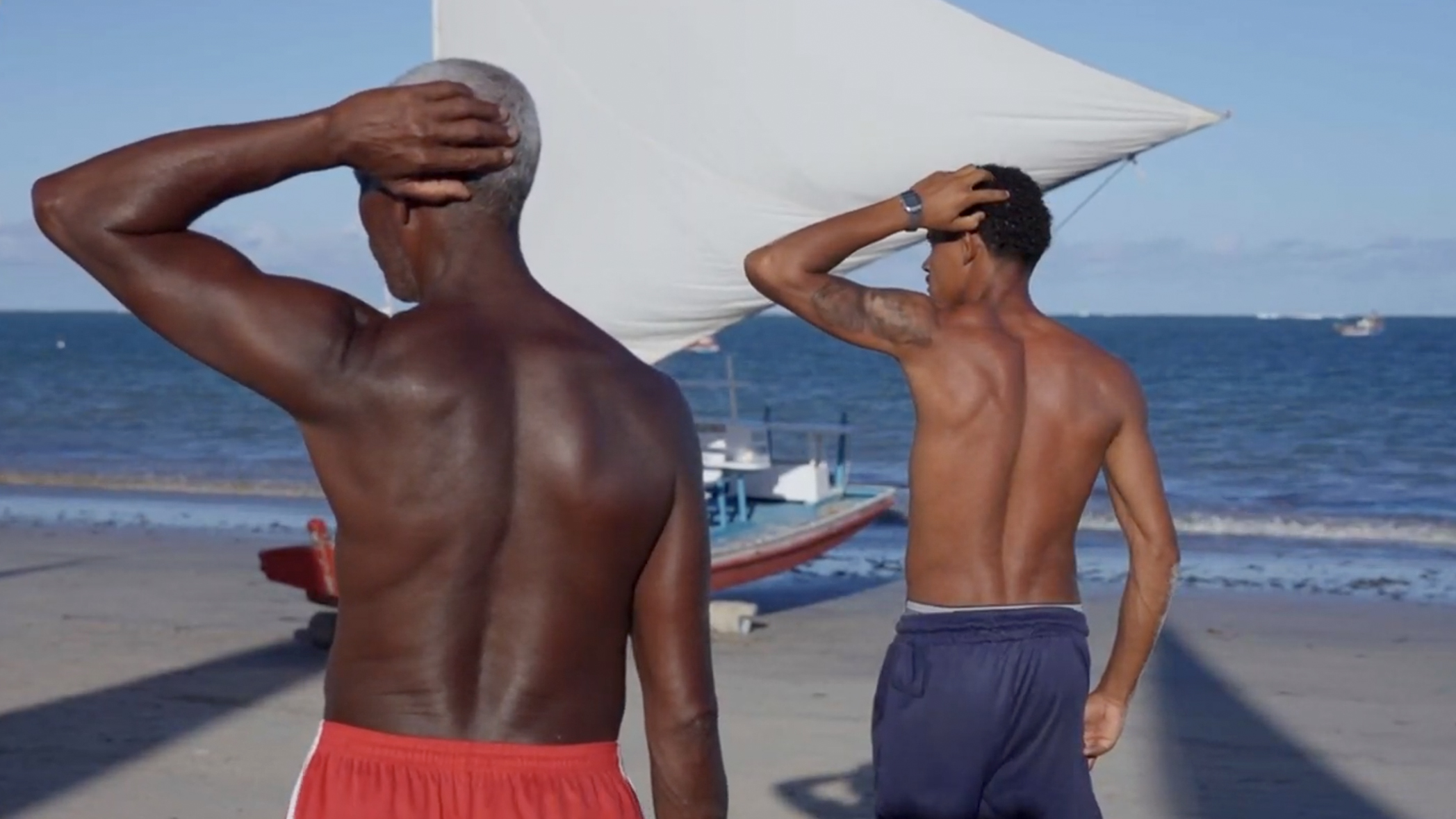
Raftsmen and Canoeists (2026) by Jonathas de Andrade opens a window onto a world shaped by wind, water and generations of skill. Set in Alagoas, Brazil, the film follows two water-based communities: the jangadeiros, who navigate handmade rafts along the coast of Maceió, and the canoeiros of the São Francisco River, locally known as Velho Chico. Bridging sea and river, the film traces a narrative through colour, form and movement.
De Andrade, whose practice is deeply embedded in the visual arts, blends documentary observation with fictional propositions developed together with communities in the Northeast of Brazil. He records the colours of rafts and canoes, as well as those embedded in daily life, through fragments of conversation in which the men describe the sea in shifting greens and blues, reading currents, depth and time through colour. These hues recur throughout the film, linking lived experience with Brazil’s history of geometric abstraction and the Neo-Concrete art of the 1960s. A percussion-based soundtrack provides rhythm and cadence to the images while echoing the effort of daily work on the water.
By focusing on collective labour, from moving rafts in and out of the sea to the gestures of everyday life, the film contrasts authentic moments with idyllic imagery, revealing the resilience, skill and quiet strength of communities shaped by tradition, environment and history: a world that lingers long after the images fade.
– Eva Langerak
This work is presented in the Kijkmodule at Rotterdam Central Station, in collaboration with Museum Boijmans Van Beuningen.