

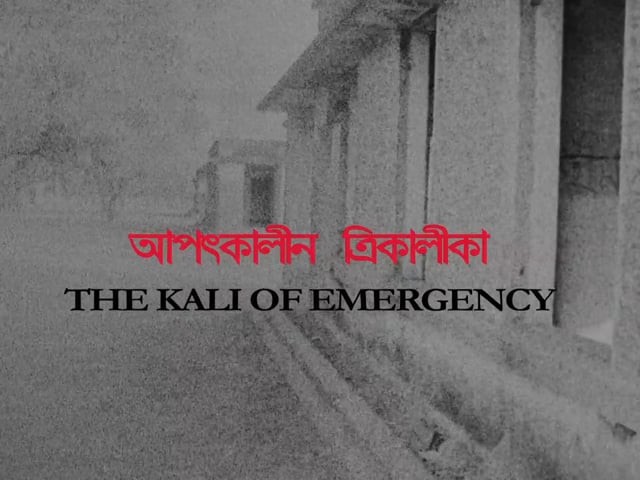
Kali of Emergency
Aapothkalin Trikalika
As the world is overwhelmed by genocides, wars and riots, the goddess Kali and her myriad manifestations decide to take physical form on Earth. However, solving the planet’s problems isn’t what they seem to be after. Wandering through domestic, industrial and forested landscapes, discussing the banalities and horrors of earthly life, they grapple with love, desire, violence and other human afflictions.
Inscrutable yet transfixing, provocative yet never scandalous, Ashish Avikunthak’s Kali of Emergency abstains from giving this premise a straightforward dramatic treatment, scattering it instead into a series of abstract tableaux in which the gods offer looping commentary, by turns monotonic and cadenced, on their profane experiences while their human forms, wearing Kali masks, engage in studied gestures and ritualised movement.
Kali of Emergency juxtaposes two kinds of Hindu iconography, mingling the elaborately costumed, stylised gods of popular representations with the austere forms found in pre-modern paintings and temple sculptures. Avikunthak’s artistic nerve consists in working these fraught references, rendered a minefield by Hindutva’s political ascent, into an idiosyncratic spiritual vision that divorces them from instrumental ends and emphasises the vernacular, heterogenous aspects of Indian religiosity. Filled with incandescent images, Kali of Emergency is of a piece with Avikunthak’s singular, personal body of work.
– Srikanth Srinivasan
Trailer
This content is available after accepting the marketing cookies.
Film details
- Countries of production
- Germany, India
- Year
- 2016
- Festival edition
- IFFR 2023
- Length
- 79'
- Medium/Format
- DCP


