
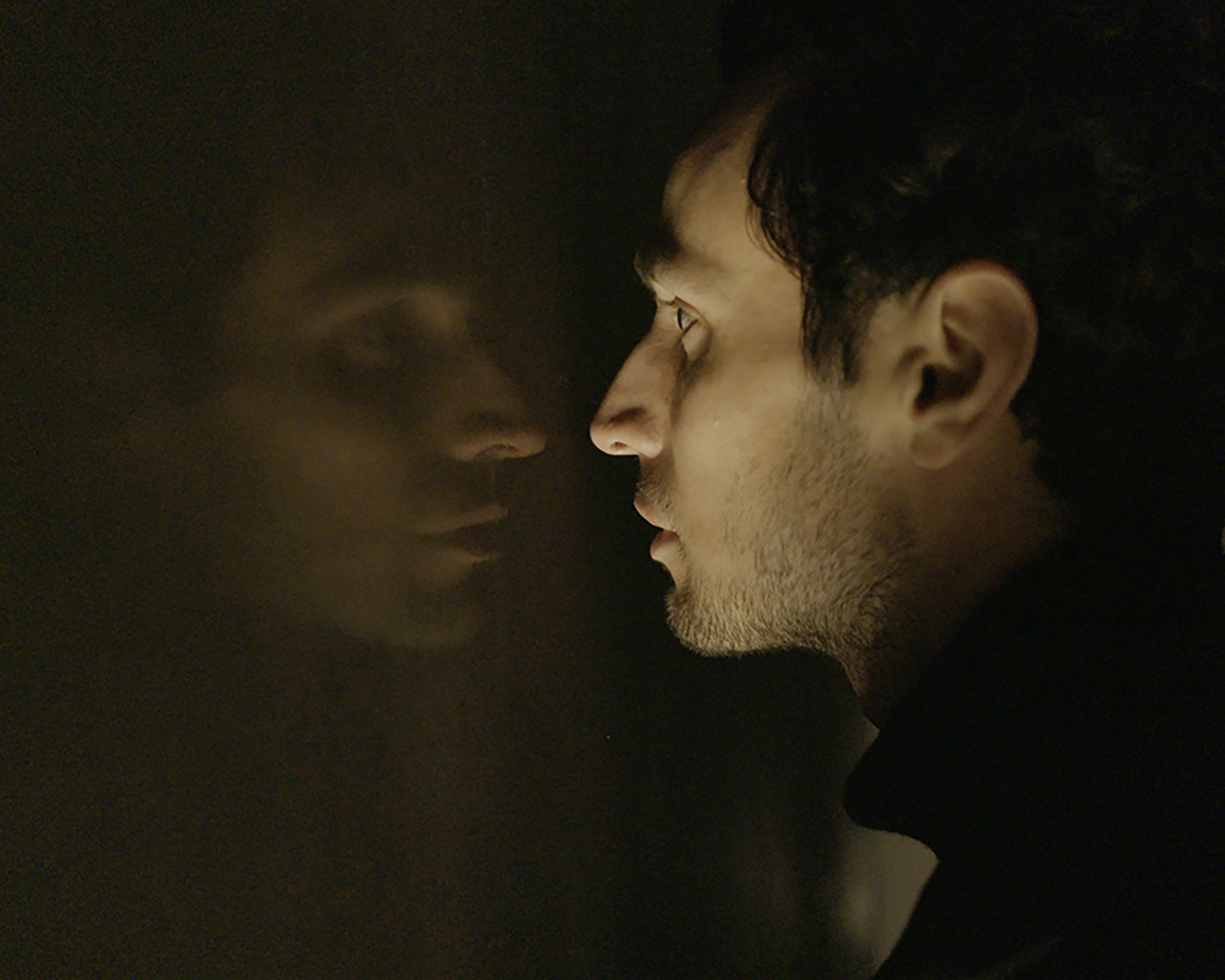
Last Trip
A former Syrian army photographer, now a refugee in Berlin, spirals into a psychological nightmare when a bondage performance reawakens buried trauma. Fleeing with his girlfriend to the Polish countryside, he’s drawn into a strange healing ritual that forces him to confront his past.
Key tags
psychological thriller, refugee story, Shibari bondage
Film details
- Productie bedrijf
- Mayana Films
- Co-Producenten
- Tiresias Films, Endorfina Studio
- Productielanden
- Syrië, Duitsland, Frankrijk, Polen, Saoedi-Arabië
- Gebaseerd op
- by Ziad Kalthoum
- Lengte
- 90'
Pitch
Deze inhoud is beschikbaar na het accepteren van de marketingcookies.

Synopsis
When the Syrian revolution erupts, Karim, a military-assigned photographer, is forced to document detainees – capturing their final days before execution. Consumed by guilt, he deserts, escaping to Berlin in search of peace. In Berlin, Karim rebuilds his life, working in a bar and training as a lifeguard. He finds solace in an intense relationship with Franzi, a German Shibari artist. But when she gifts him an old camera, buried memories resurface.
His reality fractures when he is asked to photograph one of Franzi’s performances, triggering visions of the prisoners he once documented. Haunted by the ghosts of his past, Karim spirals, drowning in trauma that even the sanctuary of the pool can no longer soothe. Desperate for redemption, he obsesses over a hidden archive of prisoner photos smuggled from Syria. Convinced that at least one detainee survived, he embarks on a frantic search, where imagination and reality blur. Meanwhile, Franzi struggles with grief over her mother’s death, as Karim’s turmoil threatens to unravel their relationship.
Hoping to heal, the couple retreats to the Polish countryside, but the eerie stillness only deepens Karim’s descent. A disturbing dinner with their neighbours, Christine and André, reignites his rage. As visions consume him, Franzi leads him on a surreal journey into the depths of the forest – a gateway into the abyss of Karim’s psyche, where he must confront his demons.
Director statement
As a child, my father handed me a rifle to shoot a small bird. That moment was my first encounter with death – and I vowed never to hold a weapon again. Yet fifteen years later, conscripted by the Syrian regime, I was forced to take one up as a soldier. I refused to shoot civilians or destroy cities, choosing instead to disobey and flee. My path led first to Beirut, another city marked by war, where I saw Syrian labourers rebuilding Beirut stone by stone under near-slave conditions – another hidden battlefield.
I fled again and arrived in Berlin, a city that promises peace. Yet even here, violence lingers in the scars of buildings and in the shadows of its streets. These traces reminded me that war never truly ends; it simply changes form. No matter where I went, I felt trapped in a recurring cycle, my role shifting each time – witness, victim, survivor.
With Last Trip, I want to show Karim’s struggle to break this same cycle. As a soldier, he was forced to photograph political prisoners before their execution, becoming the last witness to their existence. Pressing the shutter felt like pulling a trigger – an act that remains lodged in him like a slow poison.
Karim is inspired by my own experiences, though he has become a fictional character with his own wounds and desires. My co-writer, Nadja Dumouchel, helped shape this transformation, allowing reality and imagination, nightmare and poetry, to merge.
When the film begins, Karim has found a fragile sense of stability in Berlin. His lifeguard training adds new depth to the swimming pool scenes – the water as a place of refuge and fear. Then he meets Franzi, a Shibari artist. Their attraction is immediate, their relationship intense. As she introduces him to her world of bondage, fascination mixes with unease; the ropes evoke memories of the prisoners he once photographed, memories he has tried to suppress.
From here, Berlin distorts into a hallucinatory space mirroring Karim’s inner collapse. Haunted by the faces of the prisoners, he wanders through a city that becomes increasingly surreal. Franzi remains his anchor, yet the descent into trauma is one he must take alone. Only by confronting his past can he surface again. The ending reflects this: Karim finds a new, fragile balance after facing the soldier he once was.
Last Trip is also a raw and passionate love story. Karim and Franzi are drawn together by their vulnerabilities. Their search for healing is dangerous – a journey along a narrow edge where love may save them or break them. The uncertainty of their bond creates emotional tension: can love mend wounds shaped by war?
The epilogue stands as testimony to the brutality of the Syrian regime. Documentary images of prisons – doors opening, detainees stepping into the light, even children born in cells – remind us of the terror that shaped Karim’s life. These real images connect his fictional journey to a collective truth. Fiction and reality echo through one another, showing how deeply war marks individuals and societies.
For me, telling this story is a responsibility – as a filmmaker and as a human being. It is a personal perspective shaped by survival, and one I feel compelled to pass on.
Director biography
Ziad KALTHOUM (1981, Syria) is a filmmaker based in Berlin. He holds a degree in film studies. His debut documentary Oh My Heart (2009), portraying Kurdish women living in a female-only community, was banned in Syria for political reasons. During the outbreak of the Syrian revolution, he served compulsory military service while secretly directing his first feature, The Immortal Sergeant, which premiered at Locarno in 2014 and won Best Feature Documentary at the BBC Arabic Festival in 2015.
Refusing to fight his own people, Kalthoum deserted the army in 2013 and fled to Beirut, where he made Taste of Cement – a widely acclaimed documentary that won numerous international awards, including the Golden Sesterce at Visions du Réel in 2017, and received a nomination for the German Film Prize in 2018. In 2022, he was awarded an artist residency at the Cité Internationale des Arts in Paris. He is currently developing his first fiction feature, Last Trip.
Financiering en contact gegevens
- Budget
- € 1.948.681
- Financiering rond
- € 341.500
- Financierders
- Mayana Films , Medienboard (Development Fund), Red Sea Film Fund (Development Fund)
- Zoekt naar partners uit
- Worldwide
- hello@mayana.film
Huidige status
The script is fully developed (fourth draft), and the main cast is attached. The project is currently in financing, with 20% already secured. Funding applications are underway, and we are actively seeking additional financing, investors, partners, world sales and distribution.
Goals
At CineMart, our goals are to meet potential investors, funds and co-production partners, and connect with world sales agents and distributors who believe in the film’s artistic and international potential. We aim to build strategic alliances that will strengthen the project’s visibility, ensure a solid path toward production, and position the film for a strong festival and distribution trajectory.